
DRONE SWARM:
The purpose of this project is to design and build micro drones that can be manufactured easily and cheaply to form a swarm similar to the one made by Intel. The basic functionality of each drone involves following a predetermined flight path, communicating with the other drones or being controlled remotely from a base station. Each drone also includes an expansion port where a number of accessories can be attached. This means it can serve as an open source platform for all kinds of swarm projects.
Some applications I have come up with include:
- Light shows (like those done by Intel) – each drone has an LED
- Search and Rescue – each drone has a simple thermal camera
- An array of sensors spanning a large area in 3d space – each drone has a temperature / humidity / wind speed / etc. sensor
Version 1:
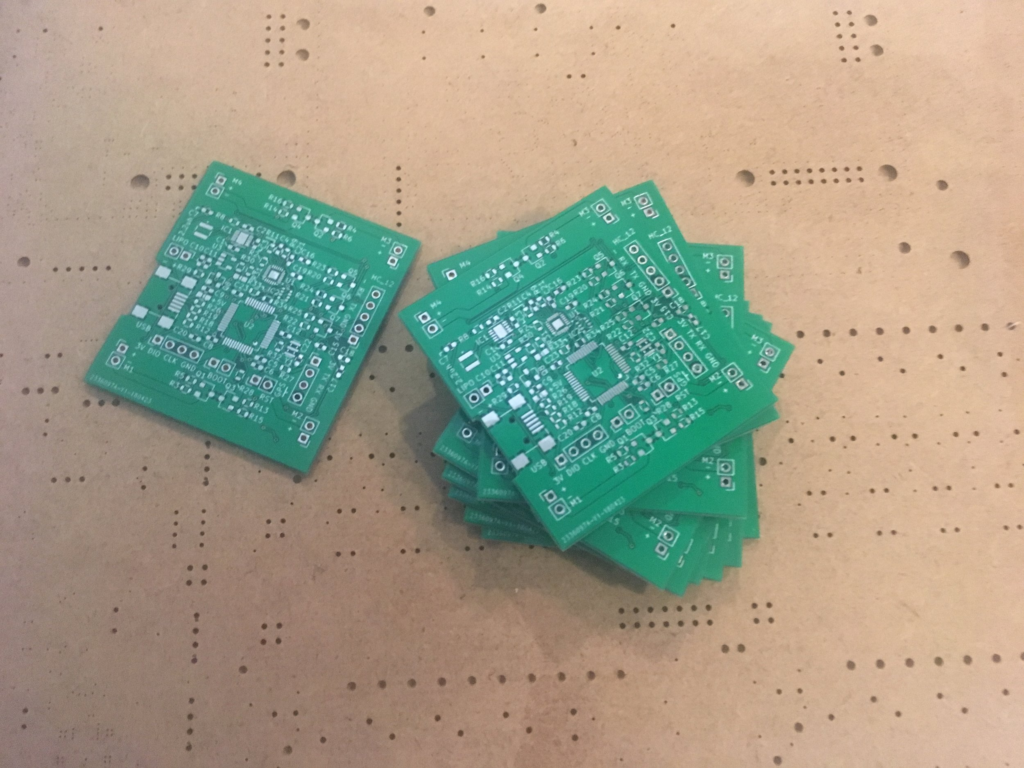
This was the first iteration of the design, where I focused on fitting all the necessary control electronics on the boards. This was the simplest version, with one circuit board handling everything: hosting the main processor, sensors, LEDs, motor drivers. Only the commercially available GPS and Radio module would be separate.
As a testbed, these boards were never meant to fly an actual drone, so they included extra functionality such as a battery charging circuit. In the final design I plan to split the board in to two parts. The first part will be the actual flying drone, with only the bare minimum: controller, sensors, radio, LEDs and motors. Everything else will be moved to a breakout board that will plug into the first board. This includes the battery charging circuit, all of the circuitry for programming, and headers to allow connection to all of the other pins on the microcontroller, if I need them.
Version 1 Board and Schematic:

Version 2:
This was the second iteration of the design, and the first one to be flight ready. By this time I had settled on a frame, motor driver and battery to use, so I designed the nonstandard shape of the board to fit around the other components. I designed and built two boards, ultimately discovering some important issues while testing them, that prompted a third version.
To the right is a log of the work I have done on this version.
Version 3:
This is the third iteration of the design, and the first one to assembled into a complete drone, ready for programming. It fixes the issues with the previous version and includes some additional features, such as a larger ground plane under the GPS module for better accuracy and a place for an XBEE wireless radio for mesh networking.
To the right is a log of the work I have done on this version.