
KRATOS (30lb Combat Robot):
This is the robot built around my axial flux motor (AFM), and was also the impetus for its creation. This type of robot is called an “overhead spinner”, where a immense spinning blade extends past the robot in every direction, and the entire chassis of the robot is built into a very flat pancake underneath the blade.
The main advantage of these robots is that the blade makes for an overwhelming offense (by virtue of having a very large moment of inertia) and an impenetrable defense (because there is no angle an enemy can approach from without contacting the spinning blade first). However, this is also the main weakness of this robot, because these advantages only come into play when the blade is spinning quickly. So to minimize this weakness, I set out to create the most powerful motor ever seen in this division of combat robotics, in order to get the blade up to speed as fast as possible. For the robot and motor, I won first prize in undergraduate research at the MIT Meche Deflorez Competition in May 2025.
Please see the poster I presented about it on the right. →
Additionally, NHRL (the competition series my team attends) created a youtube short which now has almost 5 million views.

DESIGN:
A full CAD model of the robot is viewable below:
The overall architecture of the robot was inspired by bloodsport, a 250lb overhead spinner battlebot which was one of the first to demonstrate how effective this architecture could be. Since so much weight had already gone into the motor and the spinning blade, in order to meet the 30lb weight limit, most of the chassis was made from lightweight materials like plastic and carbon fiber. The body of KRATOS is one single piece of Ultra High Molecular Weight Polyethylene, an extremely tough and impact resistant plastic. A variety of cutouts and channels in the underside of the chassis make room to mount the AFM, the VESC to drive it, the two drive motors with their ESCs, and all the batteries and supporting circuitry. All these openings get covered up by carbon fiber plates to close up the robot.
In order to mount everything to the plastic, I used a variety of threaded inserts around the chassis. We performed a variety of tests and discovered that these ones with super course threads work best in blind holes, while T nuts with spikes work best in through holes. They provided the most resistance to pulling out, stripping threads and spinning in place. However, if I were to redo this robot I would probably approach this differently since even though these were the best available inserts, they still were a significant failure point.
For the drive system, KRATOS uses two Repeat Robotics Magnum gearboxes driven by BadAss brushless motors. Two chains per side distribute power to the front and back wheels. Since the torque to spin up the weapon is reacted by friction against the ground, I wanted to ensure KRATOS had as much traction as possible so the front wheels got doubled up.
Since weight was a real concern in the design, I could not add much in terms of armor to the robot. There are 3D printed flexible TPU bumpers on the front and rear and UHMW rails on the outside of the wheels. The goal with these is for them to serve as ablative armor: sacrificial material that can be torn away by other robots before critical components are impacted. However, as mentioned previously, the massive spinning blade should be the first line of defense.
The last notable feature of the design is the weapon shaft assembly. This structure experiences the full load of impacts from the massive spinning weapon, so it needs to be extremely strong. The central component is a hollow titanium shaft running through the entire robot which we machined ourselves. It is anchored into the chassis by an aluminum bottom block that also helps with routing the many wires that must also pass through this central bottleneck. The weapon runs on a pair of tapered roller bearings which can support immense axial, radial and moment loads. These are capped a titanium nut and six titanium screws to hold the weapon on. (Lots of titanium was used here to save weight while preserving strength).
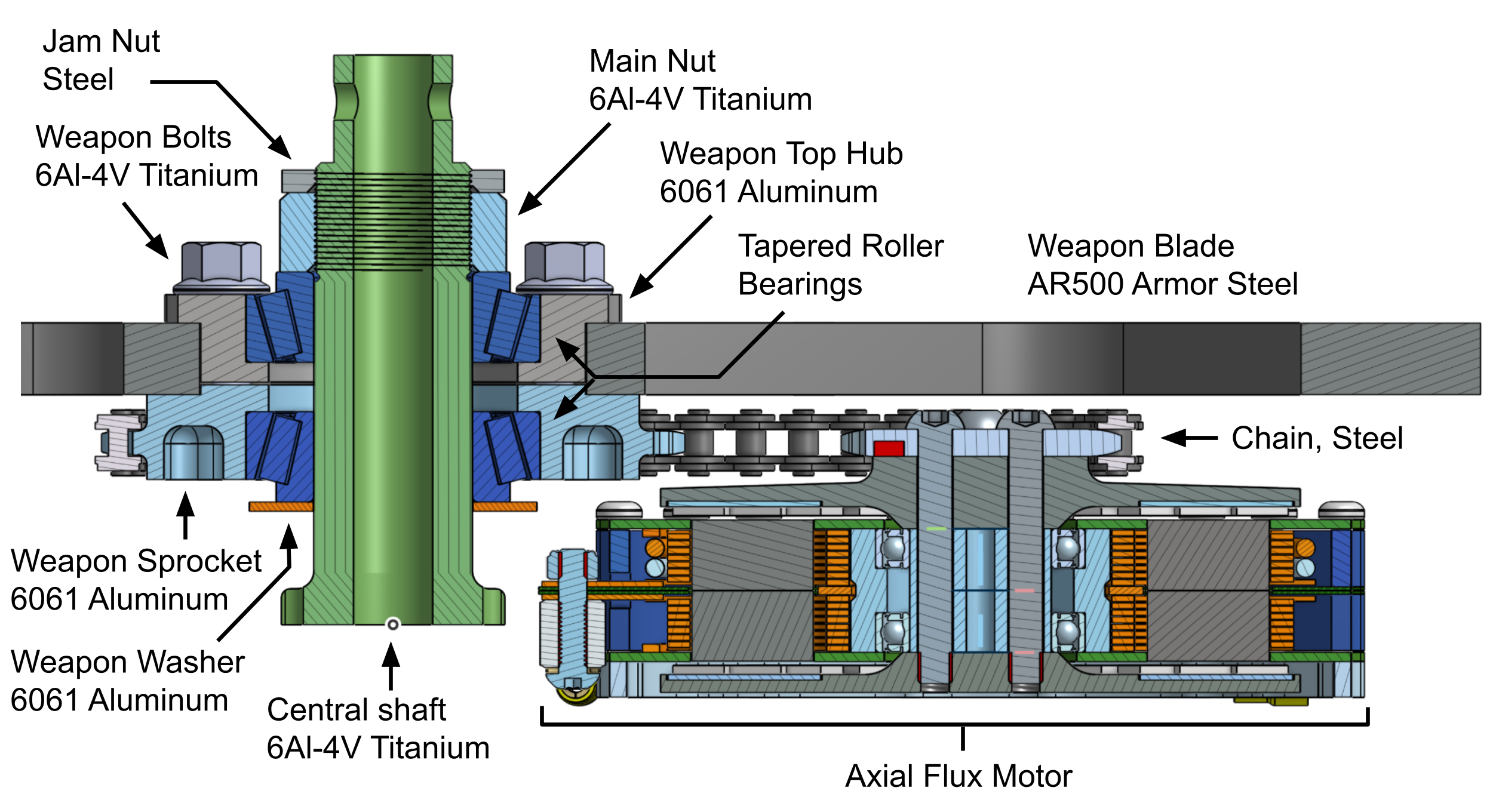
Lastly, an aluminum self-righting bar extends out the top of the robot. We bent this ourselves from a hollow aluminum tube. This is a direct implementation of bloodsport’s self-righting mechanism, which helps the robot hoist itself back onto its wheels if it gets flipped over. Here is a video of KRATOS self-righting:
WEapon Changes and ConClusion:
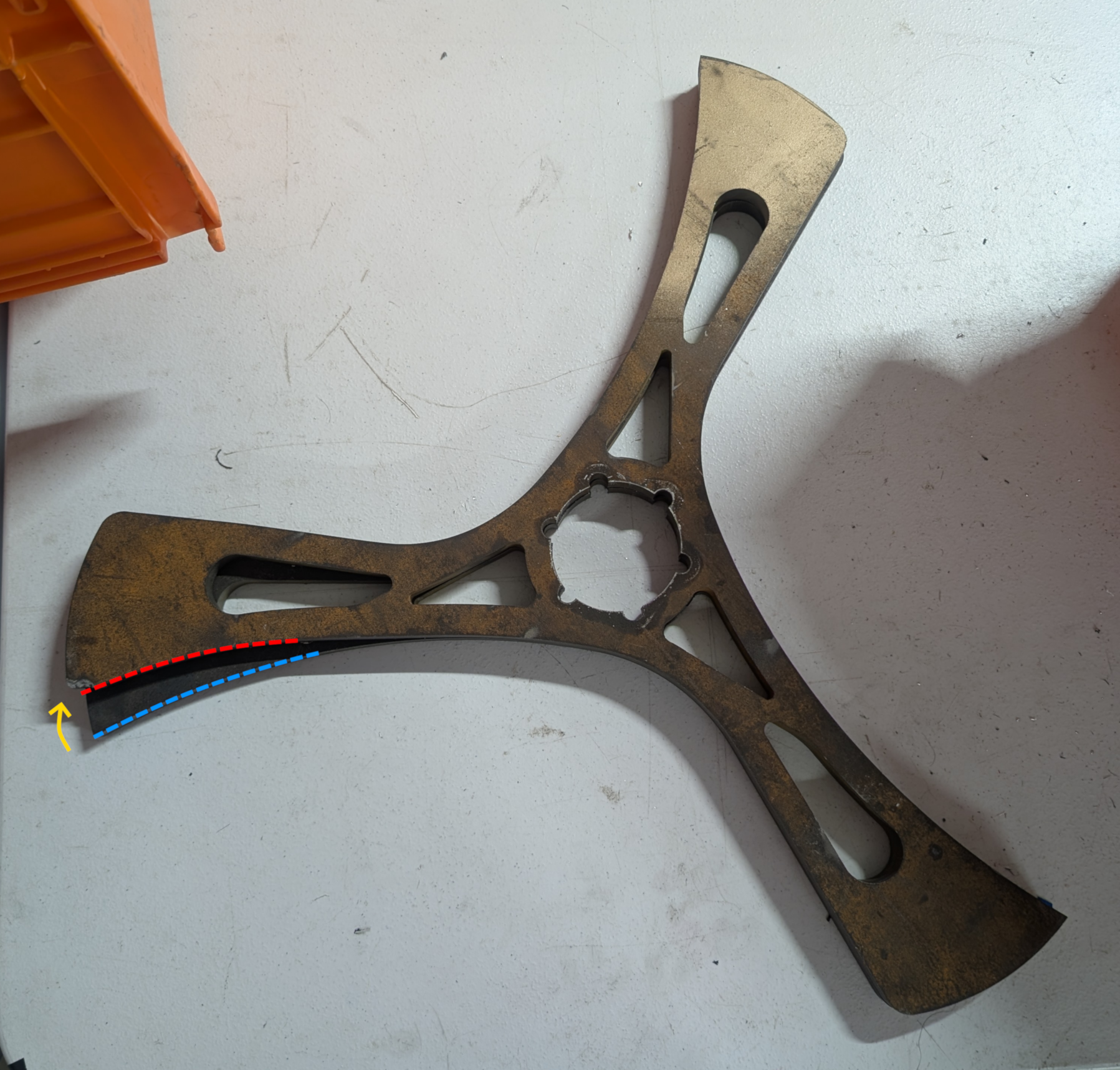
Before I retired from MIT Combat Robotics, KRATOS was able to compete twice at March and April NHRL 2025. The first appearance was plagued by a number of issues, primarily that I was trying to use sensorless operation on the AFM under the assumption that adding hall effect sensors presented another point of failure. Unfortunately, despite spending days configuring it, I could never get it to work properly. However, we did get one good hit in, which surfaced another issue: the design was too powerful for my tribar weapon design. I had originally chosen a tri bar because it gave good coverage of the chassis, protecting the robot well against attacks from the top. However, on our first big hit, the bar bent demonstrating that splitting the weight across 3 arms made each individual one too weak.
I revised this by switching to a single tooth design, allowing me to make the arm supporting it significantly stronger while keeping the weight about the same. Here are simulation results comparing the two designs with an identical load. The single tooth bar has less than half the peak stress and deforms much less.
In between the April in March events, I significantly improved the motor control scheme. This video shows some of the highlights:
With this improvement and a new sensored control scheme, the robot performed better. There are still several kinks to work out, but in the time that I had to work on it, I was able to demonstrate that custom motors can be built for combat robotics and lead to very effective designs.